
If you’ve been looking at homes in Southern New Hampshire or across the border in Vermont lately, you’ve probably heard the term "PFAS" thrown around. It usually comes up right after the home inspector mentions radon or lead paint.
As the owner of Norway Hill Home Inspection Services, I get asked the same question at least three times a week: "Kurtis, is this PFAS testing actually necessary, or is it just another way to add $200 to my bill?"
I get it. Buying a home in Manchester or Merrimack is already expensive enough. You’re being hit with closing costs, moving fees, and a mountain of paperwork. The last thing you want is a "scare tactic" upsell.
But here’s the straight talk: In our corner of New England, PFAS isn't a marketing gimmick. It is a legitimate environmental factor that can affect your health, your property value, and your ability to sell the home down the road.
Let’s break down the facts, the risks, and: most importantly: the solutions so you can make a strategic decision for your family.
What Exactly Are We Talking About?
PFAS (per- and polyfluoroalkyl substances) are often called "forever chemicals." They were designed to be indestructible, used for decades in everything from non-stick cookware and waterproof jackets to firefighting foam. Because they don’t break down, they leach into the soil and eventually hit the groundwater.
In New Hampshire, we have a bit of a "perfect storm" for PFAS. Between legacy industrial manufacturing and our heavy reliance on private wells, we are currently at the center of some of the strictest water quality conversations in the country.

The Southern NH Situation: It’s Personal
If you’re looking at homes in Merrimack, Bedford, Litchfield, or Londonderry, you’re likely familiar with the Saint-Gobain Performance Plastics situation. For years, industrial emissions from that facility landed on the ground and filtered into the aquifer.
But it’s not just one factory. In areas near Manchester-Boston Regional Airport or local fire training sites, firefighting foams have contributed to elevated levels. Up in Vermont and more rural parts of New Hampshire, the risks are often lower, but private wells are still wildcards. Unlike public water systems, which are strictly regulated and tested by the municipality, your private well is your responsibility.
The state of New Hampshire estimates that about 9% of private wells contain PFAS levels above the legal limit. Even more concerning, roughly 30% of wells tested show some evidence of these chemicals.
Is This a Deal-Breaker? (Spoiler: No)
One of the biggest mistakes I see buyers make is panicking when they see a water report come back with a "hit." They think the house is toxic and the deal is dead.
At Norway Hill, we look at an inspection report as a strategic negotiation tool. A high PFAS reading isn't a reason to walk away; it’s a reason to sit down and build a Repair Roadmap.
Everything is fixable. If a well has PFAS, we don't just hand you a scary number and wish you luck. We explain what that number means in the context of NH state standards and help you understand the cost of the fix. In many cases, this becomes a point of negotiation where the seller may cover the cost of a filtration system or provide a credit at closing.
Your 3-Step Path to Water Confidence
We’ve designed our inspection process to remove the "fear of the unknown." Here is how we handle PFAS testing at Norway Hill:
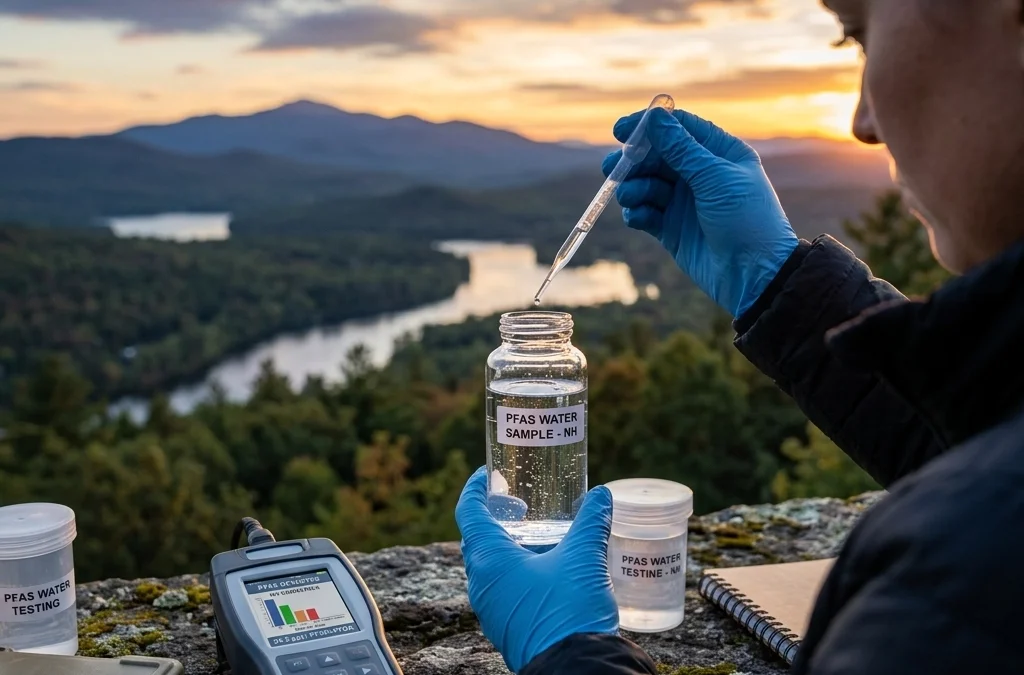
- The Strategic Sample: We don't just fill a bottle. We take samples following strict protocols to ensure there is no cross-contamination. We focus on the specific compounds: PFOA, PFOS, PFHxS, and PFNA: that New Hampshire regulates most strictly.
- Clear, No-Jargon Results: Within a week, you get a report that clearly states if your water is within state limits. No guesswork, no fluff.
- The Repair Roadmap: If the levels are high, we provide you with the information you need to move forward. We’ll outline the types of systems (like Point-of-Entry filtration) that solve the problem, turning a "scary" chemical issue into a standard maintenance item.

New Disclosures: You Can’t Ignore This Anymore
As of the last few years, NH state law has caught up with the science. Sellers are now often required to disclose what they know about PFAS on the property. If you buy a house without testing, and then try to sell it four years from now, you will be the one responsible for disclosing those levels to the next buyer.
If you skip the test now to save a few hundred bucks, you might be inheriting a multi-thousand-dollar problem that you'll have to fix out of your own pocket when you eventually go to sell. Testing now protects your future equity.
The Solution: How We Fix It
I want to be very clear: PFAS is a solvable problem. You do not need to give up on your dream home in Merrimack just because the well has forever chemicals.
Technology has come a long way. There are two primary ways these chemicals are removed from residential water:
- Granular Activated Carbon (GAC): This is the most common "whole house" solution. It uses large tanks of specialized carbon to "scrub" the PFAS out of the water as it enters the home. It’s effective, reliable, and relatively easy to maintain.
- Reverse Osmosis (RO): Usually installed under the kitchen sink, RO systems use a membrane to filter out almost everything. These are great for drinking and cooking water but don't protect the water you use for showering or laundry.
When we find elevated levels, we recommend a professional consultation to determine which system fits the home's layout. Knowing the cost of these systems (usually ranging from $2,000 to $5,000) allows you to negotiate with the seller from a position of strength.

The Bottom Line: Upsell or Real Risk?
To answer the question I started with: For a home on public water in a well-managed town, a PFAS test might be redundant. But if you are buying a home with a private well in Southern NH or VT, testing is a strategic necessity.
It’s not about being "scared" of the water. It’s about being an informed homeowner. When you know exactly what’s in your water, you have peace of mind. You aren't guessing about your family's health, and you aren't guessing about your home's value.
Ready to Move Forward?
If you’re currently under contract or just starting your search, don't let the technical talk overwhelm you. Our team at Norway Hill is here to act as your advocate. We’ve performed thousands of home buyer inspections across the region, and we know exactly what to look for in our local soil and water.
Don't leave your water quality to chance.
- Review our home inspection checklist to see where water testing fits into your due diligence.
- Schedule your inspection today and ensure PFAS testing is included in your package.
- Rest easy knowing you have a "Repair Roadmap" in your back pocket.
Buying a home is the biggest investment you’ll ever make. Let’s make sure it’s a safe one.
Kurtis Grassett
Owner/General Manager
Norway Hill Home Inspection Services
