
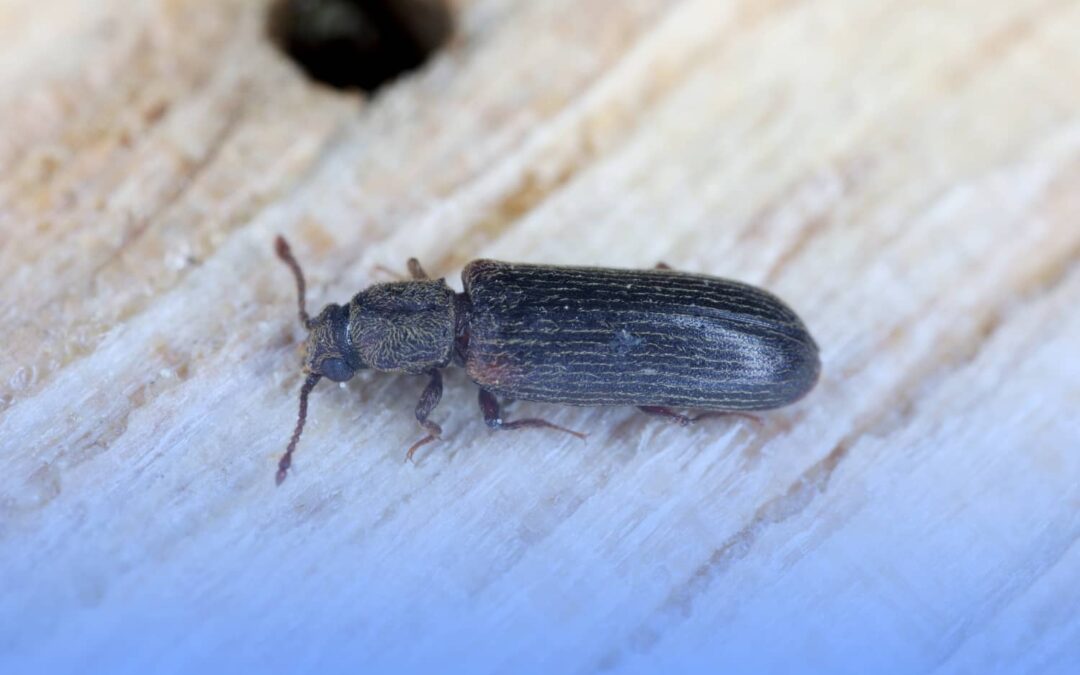
A WDI inspection is a licensed pest professional’s visual examination of a home for evidence of wood-destroying insects and any structural damage they have caused. For buyers in New Hampshire and Vermont, it is one of the most important reports in a real estate transaction: the findings can affect your mortgage approval, your closing timeline, and your long-term repair costs.
This guide covers what a WDI inspection includes, which insects inspectors look for in New England, what the NPMA-33 report means, and how to protect your investment before and after closing.
What Is a WDI Inspection?
A WDI inspection (short for wood-destroying insect inspection) is a standardized, visual survey of a property’s accessible areas, conducted by a licensed pest control professional.
The inspector checks for signs of active or past infestation by insects known to damage wood: termites, carpenter ants, carpenter bees, and powderpost or wood-boring beetles.
The findings are documented on the NPMA-33 form, which is the nationally standardized Wood-Destroying Insect Inspection Report. Mortgage lenders, particularly those issuing VA and FHA loans, require this form as part of the underwriting process.
One important distinction: a WDI inspection is visual only. Inspectors examine accessible areas such as crawl spaces, attics, exposed framing, basements, sill plates, and exterior wood, but they do not open walls, remove insulation, or probe hidden cavities.
A clean report confirms no visible evidence on the day of the inspection. It is not a guarantee that the home is free of insects.
A WDI inspection is also different from a standard home inspection. In most New England states, including New Hampshire and Vermont, WDI inspections must be performed by a licensed pest control professional, even if your home inspector walks the same property.
Norway Hill Home Inspections offers WDI inspections conducted by certified inspectors, so buyers can schedule both inspections together.
The Four Wood-Destroying Insects Inspectors Look For in New England
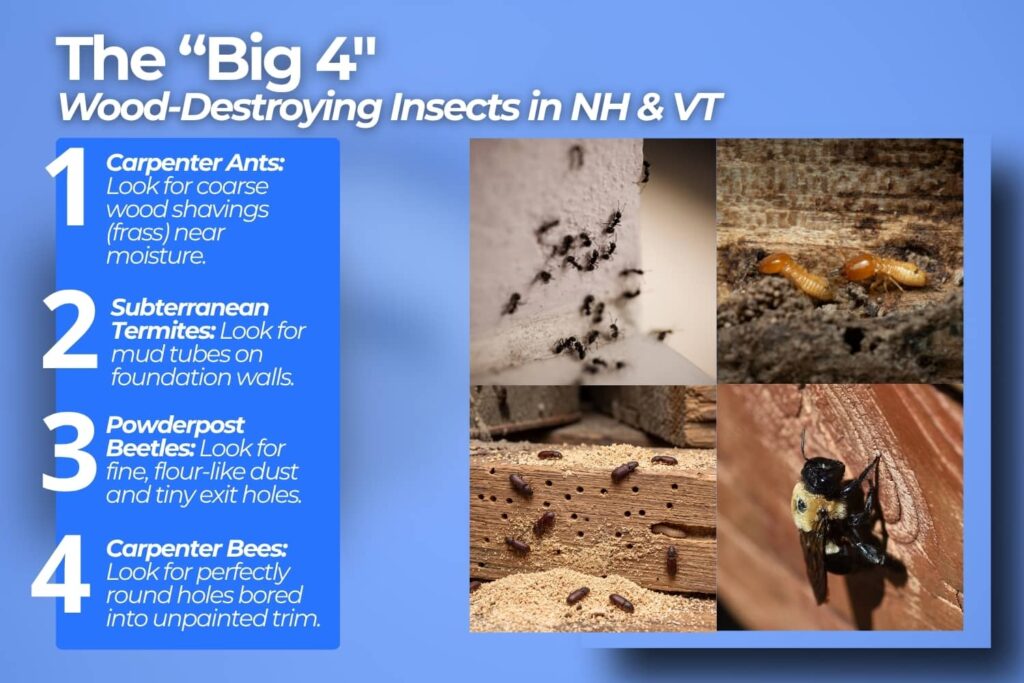
New England’s wood-destroying insect profile differs from the rest of the country. Buyers relocating from the South may expect termites to be the main concern, but in NH and VT, carpenter ants are the most common finding on WDI reports.
Carpenter Ants
Carpenter ants do not eat wood. They excavate it to build nesting galleries, preferring moist, soft, or already-decaying wood. In New England homes, they are most often found in sill plates, window frames, and structural framing near plumbing leaks or roof moisture intrusion.
Signs include coarse frass (a mix of wood shavings and insect debris), faint rustling sounds inside walls, and ant trails near moisture sources.
Subterranean Termites
Subterranean termites are present in southern New England, including Connecticut, Massachusetts, Rhode Island, and coastal New Hampshire. Their range is expanding northward, but Vermont and northern New Hampshire have lower termite risk than mid-Atlantic states.
Inspectors still check for them on every report. Signs include mud tubes along foundation walls, hollow-sounding wood, and damaged structural members.
Powderpost Beetles
Powderpost beetles lay eggs inside hardwood. Their larvae tunnel through the wood for one to five years before emerging as adults, leaving behind fine, flour-like frass and tiny exit holes in the surface.
They are common in New England homes with older hardwood flooring, antique woodwork, and exposed beams. Infestations can go undetected for years before the surface damage becomes visible.
Carpenter Bees
Carpenter bees bore into unpainted or weathered wood to build nesting tunnels. They are a frequent finding on older New England Capes and colonials with wood trim and fascia boards.
Structural damage from carpenter bees is usually limited to the immediate nesting area, but left untreated, the same tunnels are reused and expanded each season.
What Does an Inspector Actually Look For?
Inspectors survey the areas defined by the NPMA-33 form and document both active infestations and evidence of past damage. Key inspection targets include:
- Sill plates and band joists (the wood members closest to the foundation, most exposed to ground moisture)
- Crawl spaces and basement framing
- Attic framing and roof sheathing
- Exterior wood: trim, fascia, decking, door frames, and window sills
- Garage framing and any wood-to-soil contact points
The evidence inspectors’ document includes mud tubes, frass, exit holes, discarded swarm wings, hollow-sounding wood, staining or discoloration, and visible galleries or tunneling.
Keep in mind that inspectors cannot see inside walls, under finished flooring, or behind insulation. Moisture intrusion is one of the leading causes of carpenter ant activity, and a WDI inspection often flags areas where a moisture or mold problem is also present. If you are curious how those two inspections overlap, the post on how home inspectors test for mold covers the process in detail.
The NPMA-33 Report and What It Means for Your Home Purchase
The NPMA-33 is the nationally standardized Wood-Destroying Insect Inspection Report. Per the official HUD NPMA-33 form, the report explicitly states it “is not a guarantee or warranty as to the absence of wood destroying insects.” A clear report reflects what was visible and accessible on inspection day, not a certification that the home is free of pests.
The form documents four categories:
- Visible evidence of active infestation
- Visible evidence of previous infestation that has been treated
- Visible evidence of previous infestation that has NOT been treated
- Visible damage to wood members
VA and FHA loan requirements. The VA Home Loan program requires a WDI inspection for all purchase transactions in states with significant termite risk, and most New England lenders require the inspection as part of standard underwriting regardless of loan type. If your financing involves a government-backed loan, schedule the WDI inspection early to avoid delays at closing.
WDI vs. WDO. Some lenders and states refer to a “WDO” inspection (Wood-Destroying Organisms), which also covers wood-decaying fungi and moisture damage. A WDI inspection covers insects only. If your lender requests a WDO inspection, confirm the scope before scheduling.
Report validity. WDI reports are valid for approximately 90 days. If your closing is delayed beyond that window, a re-inspection may be required by your lender.
How to Reduce Your Risk of Wood-Destroying Insect Damage
Buyers who find WDI evidence during an inspection can negotiate for treatment, request a price adjustment, or walk away during their contingency period. But the better outcome is prevention. These steps reduce the conditions that attract wood-destroying insects to New England homes:
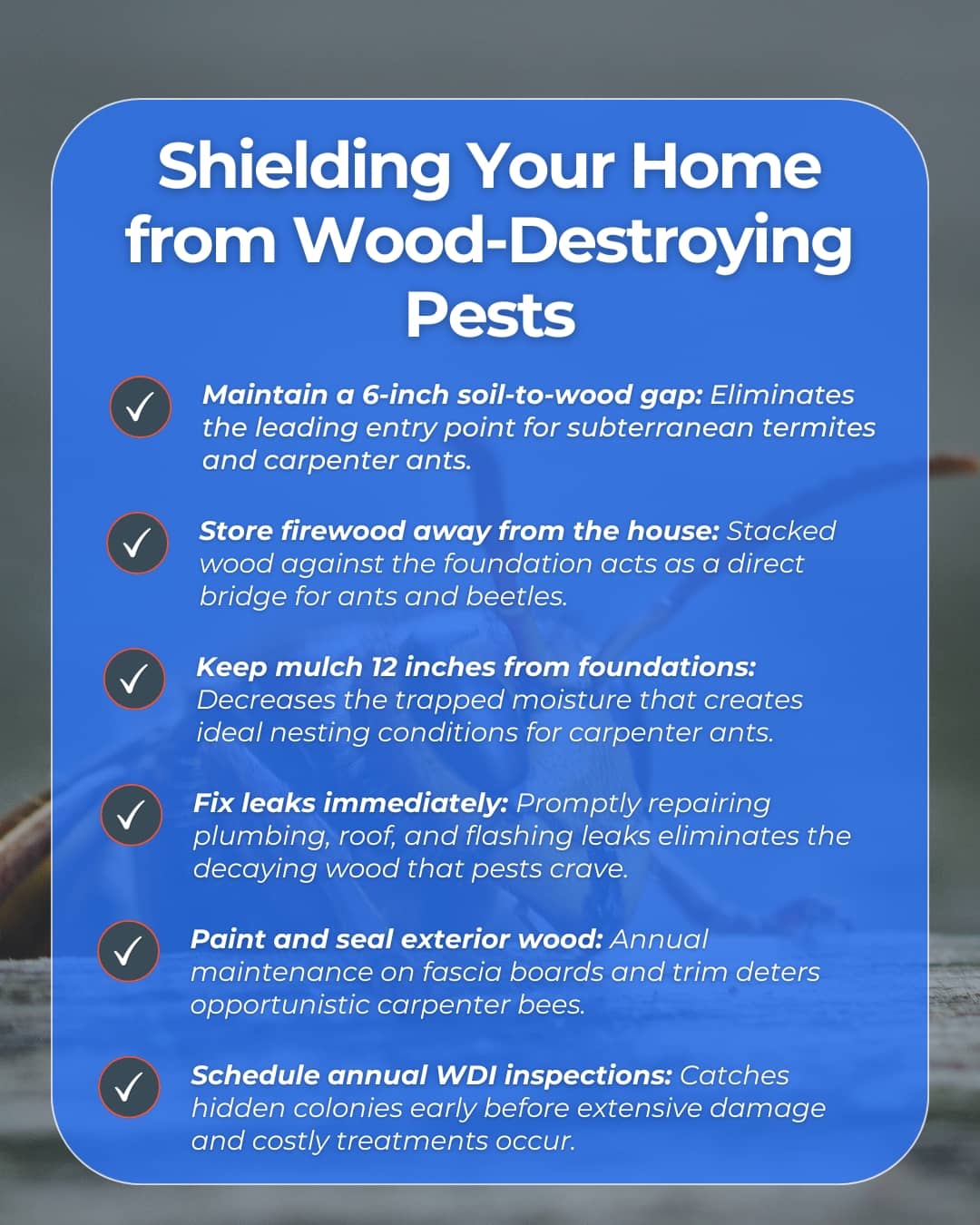
- Keep a 6-inch gap between soil and any wood framing. Wood-to-soil contact is the leading entry point for subterranean termites and carpenter ants.
- Store firewood away from the foundation. Firewood stacked against the house is a direct bridge for carpenter ants and powderpost beetles.
- Pull mulch at least 12 inches from foundation walls. Mulch retains moisture and creates favorable nesting conditions for carpenter ants.
- Fix leaks without delay. Roof leaks, plumbing drips, and failing flashing create the moist, decaying wood that carpenter ant colonies prefer for nesting.
- Paint and seal all exterior wood. Unpainted fascia boards and trim attract carpenter bees. Annual exterior maintenance keeps these surfaces protected.
- Schedule annual WDI checks. Carpenter ant colonies can grow undetected for multiple seasons inside wall cavities before surface evidence appears. Annual inspections catch activity early, when the cost of treatment is lowest.
The same principle applies to problems that show up only after a buyer moves in. For a broader look at what early inspections catch in new and existing homes, see our post on hidden issues that only a new construction inspection reveals.
Related Questions to Explore
Can a standard home inspection identify wood-destroying insects?
While a comprehensive home inspection evaluates the overall structural integrity and major systems of a house, it is distinct from a dedicated pest assessment. Booking both evaluations concurrently ensures that general wear, structural defects, and hidden insect activity are all thoroughly documented during a single property visit.
Should sellers schedule a pest check before listing a property?
Yes. Incorporating a wood-destroying insect check into a pre-listing inspection allows sellers to identify and treat active infestations before putting the house on the market. Addressing these issues early prevents last-minute closing delays, price renegotiations, and financing hurdles for potential buyers.
What other environmental tests should be considered during a home purchase?
Pest evaluations are just one component of assessing a property’s safety. Depending on the age and location of the property, buyers frequently bundle these checks with radon air testing, comprehensive well water testing, and specialized mold testing or lead inspections to ensure a completely healthy living environment.
Do newly constructed homes require checking for wood-destroying insects?
Even brand-new properties face risks if structural lumber was exposed to moisture or soil during the building process. Verifying pest safety alongside a final construction inspection or during a subsequent warranty inspection protects your investment before builder coverages expire.
When to Schedule a WDI Inspection
Schedule a WDI inspection as soon as your offer is accepted and your inspection period opens. In New Hampshire and Vermont, spring through early fall is the best window: insects are active, evidence is visible, and inspectors can fully access crawl spaces and exterior wood.
A winter inspection on a heavily insulated property with frozen ground can yield a clean report even when dormant carpenter ant activity is present in the walls.
For a standard home purchase, plan to schedule the WDI inspection on the same day as your full home inspection. This keeps your due diligence period efficient and puts all reports in your hands before your contingency deadline.
For homeowners who are not in a transaction, an annual WDI check is a sensible precaution for any older New England home with a crawl space, unfinished basement, or areas of known moisture history. Catching activity early keeps treatment costs manageable and prevents structural damage from developing over multiple seasons.
Norway Hill’s certified inspectors, including Certified Master Inspector Josh Cass, serve homebuyers across New Hampshire and Vermont. You can learn more about our WDI inspection service and schedule your inspection online. For more on what ancillary inspections cover, the post on why fall is the right time for a lead inspection walks through another commonly overlooked inspection category.
Conclusion
A WDI inspection is a straightforward step in the homebuying process. It gives you documented evidence of what was visible on inspection day, supports your negotiating position if problems are found, and satisfies your lender’s requirements for a government-backed loan.
Key takeaways:
- A WDI inspection covers four insect types, not just termites. In New Hampshire and Vermont, carpenter ants are the most common finding.
- The NPMA-33 report is the standard document required by VA and FHA lenders. It is not a warranty or a guarantee.
- WDI reports are typically valid for 90 days. Schedule early to stay within your closing timeline.
Norway Hill Home Inspections is certified to conduct WDI inspections in New Hampshire and Vermont. Schedule your wood-destroying insect inspection alongside your full home inspection to receive all your reports in a single site visit.